

This month's Weaver is packed with wonderful information and messages from your Leader and SGP Executive. Stay up to date. Be informed.


The Threat to Our Prairie Ecosystem from Non-native Species
Non-native invasive species threaten the Prairies by aggressively outcompeting native plants and animals, thus reducing biodiversity and damaging soil health.
Non-native and invasive animals in Saskatchewan – such as wild boars, common carp and Prussian carp – severely threaten local wildlife by destroying fragile habitats and spreading dangerous diseases. Saskatchewan needs stronger legislation in place to prevent future non-native species incursions and to combat those already here.
Non-native plants, birds, animals, bugs and aquatic creatures can all play a part in the decline of native and beneficial species in a given area. Invasive species are actually the second most significant threat to biodiversity.
As always, knowledge is a vital weapon in fighting such problems. I have been amazed lately at several otherwise very well-intentioned people who were unaware of the problems non-native species cause here on the prairies.
We must have a government that prioritizes scientific evidence and stands committed to protecting our natural biodiversity. Implementing legislation to safeguard our native species from danger needs to be a primary focus. Once elected, the Saskatchewan Green Party will work tirelessly to reinforce these critical biodiversity protections.

Your SGP 2026 Executive
Party Leader: Naomi Hunter - [email protected]
President: Mike Hamm - [email protected]
Vice-president: Remi Rheault - [email protected]
Secretary: Whitney Greenleaf
Treasurer/COA: Sherry Olson
Organizing Chair: Sean Muirhead
Fundraising: Nancy Carswell
Northern Youth Rep.: open
Southern Youth Rep.: Darry Michelle
Member-at-Large: Bo Chen
Member-at-Large: Mikayla Schultz
Member-at-Large: Alison (Ven) Feland
SGP Online Links
https://www.facebook.com/SaskGreenParty
https://www.facebook.com/NaomiHunterGPC
Important Upcoming Dates:
- SGP Executive Meeting - Sunday, August 9
- The Weaver Editorial Planning Meeting - Tuesday, August 25
- Weaver Publishing Date - Sunday, August 30
Petitions - Take Action and Please Sign
You can make a difference.
Together, we can create real change in this province. As people across the province mobilize and add their voices to petitions for change, we build strength and resilience together. Add your voice today.
End Homelessness in Saskatchewan
https://www.saskgreen.ca/end_homelessness_in_saskatchewan
Ending Poverty in Saskatchewan
https://www.saskgreen.ca/ending_poverty_in_saskatchewan
SK must act now to remove asbestos from our drinking water
https://www.saskgreen.ca/asbestos_in_our_drinking_water
SK needs a Wetlands Policy
https://www.saskgreen.ca/sk_needs_a_wetlands_policy
SK needs Renewable Energy, not nuclear waste.
https://www.saskgreen.ca/sk_needs_renewable_energy_not_nuclear_waste
SK demands a new approach to healthcare
https://www.saskgreen.ca/sk_demands_a_new_approach_to_healthcare

Green Party's Tayte Willows wins P.E.I. byelection, beating Liberal leader
The Canadian Press, July 19, 2026 - The Green Party has been declared the unofficial winner in a Prince Edward Island byelection that gives it the same number of seats in the legislature as the Opposition Liberals.
The provincial byelection in Cornwall-Meadowbank was called after Progressive Conservative cabinet minister Mark McLane died in March.
Tayte Willows of the Green Party received almost 1,200 votes, representing nearly 40 percent of the ballots cast.
Liberal Leader Robert Mitchell was in second place with more than 950 votes, while Caley McDonald of the Progressive Conservatives was a close third and NDP candidate Craig Nash a distant fourth.
Saskatchewan healthcare workers issue urgent warning ahead of strike
Saskatchewan Today, by Denis Conroy, July 22, 2026 - After more than three years without a new collective agreement, thousands of Saskatchewan health care workers say patience is running out as growing staffing shortages, rising living costs and mounting workplace pressures push them toward a provincewide strike vote this September.
For nearly every Saskatchewan resident, health care is something they depend on during life's most critical moments. But the frontline workers who keep that system running say the pressures behind the scenes have reached a point where the status quo can no longer continue.
CUPE Local 5430, Saskatchewan's largest health care union representing more than 14,000 frontline workers, has announced it will hold a strike vote in September after what it describes as years of stalled bargaining, falling wages and worsening staffing shortages. Members work in hospitals, long-term care homes, laboratories, community health centres and medical facilities across the province.
Union leaders stress that the decision is not about walking away from patients. They say it is about fighting for a health care system capable of attracting and keeping the skilled professionals Saskatchewan families depend on every day.
$46.4 Billion for the cost of coal
Brett Dolter, July 23, 2026 - The province of Saskatchewan is proposing to extend the life of its coal-fired power plants beyond their regulated retirement dates until its small modular nuclear reactors (SMRs) come on line.
This would mean missing Canada’s 2030 goal to eliminate coal-fired electricity generation, and adding 116 to 119 more megatonnes (Mt) in greenhouse gas emissions between 2030 and 2050, than using a mix of natural gas and renewables. A coal-to-SMR scenario would also be more costly for Saskatchewan ratepayers.
SaskPower, the Crown generation and transmission utility, was ordered last year to ditch its planned coal phase-out “beyond 2030 and out as far as 2050” and instead refurbish its three aging plants.
Big Reactors in Small Provinces: What could go wrong?
By Mark Winfield and Susan O'Donnell, April 30, 2026 - At the end of March, the NB Power Review Panel report recommended considering building a new large nuclear reactor at the Point Lepreau site in New Brunswick. That recommendation raises a series of questions, not least whether the province can afford a new reactor, how it would be paid for, and its impact on electricity rates and the province’s overall financial position. The situation in New Brunswick would have wider implications as well, particularly smaller provinces considering nuclear projects, like Saskatchewan.
Petition: People and Planet Before AI Data Centres
Canadians deserve transparency, local control, and accountability over AI infrastructure. Sign this petition to demand democratic oversight, independent evidence, and responsible policies that protect our communities, energy security, planet, and jobs.
The Purple Party Paradox
By SGP Member Nancy Carswell, July 6, 2026 - Let’s imagine that the new Purple Party is second-past-the-post in each of Canada’s 343 ridings. How many seats would they win in the House of Commons? Zero. Yes, zero! This highlights our need for electoral reform with proportional representation.
Following Our Corrections System Money: Who Benefits?
By Lindsay Hunt and Karen Ridd, Quakers Canadian Friends Service Committee
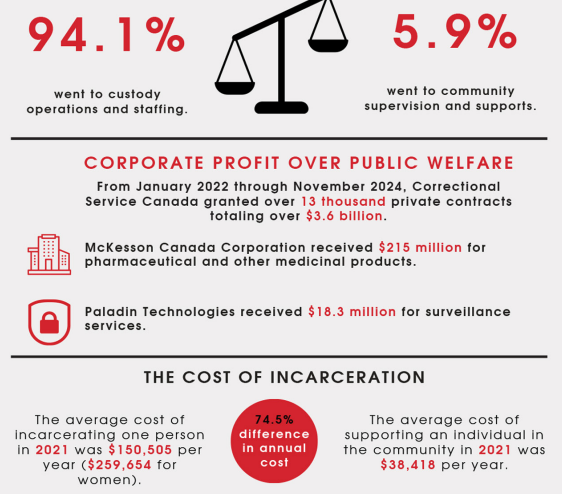
Following the Money: Cui Bono Report uses the guiding question “cui bono” (“who benefits?”) to investigate Canada’s carceral system and the economic interests that surround it. The report starts with this imbalance: 94.1% went to custody operations and staffing, 5.9% went to community supervision and support.
Clean power pathways beat carbon capture
By David Suzuki with contributions from Senior Editor and Writer Ian Hanington, July 23, 2026 - An agreement between the federal and Alberta governments and five oil companies includes significant incentives, including funding and investment tax credits, for the Pathways Project (costing up to $30 billion — or more) to capture, transport and store oilsands emissions. The project is part of a deal to build a multi-billion-dollar taxpayer-funded pipeline to move diluted oilsands bitumen from Alberta to British Columbia’s south coast.
FACT SHEET: Climate change and wildfires
Canadian Climate Institute, July 10, 2026 - Accelerating climate change, largely from the burning of fossil fuels, makes wildfires bigger, hotter, and more destructive (Climate Atlas of Canada n.d.). With Canada warming twice as fast as the global average (Government of Canada 2019), and home to more than a quarter of the world’s boreal forests, the country is experiencing this consequence of global heating firsthand.
The last three fire seasons have been among the 10 worst on record. Canada experienced its most destructive wildfire season ever in 2023, with fires consuming 16.5 million hectares—more than double the previous record and nearly seven times more than the historical average (Natural Resources Canada 2024).
Big win for clean energy at Sask Polytech
Moose Jaw Today, July 8 2026 - SASKATOON — Energy and Resources Lab wins Regional Centre of Expertise award, multiple projects acknowledged
Saskatchewan Polytechnic is being recognized for its leadership in sustainability and applied research, earning multiple honours at the 2026 Regional Centre of Expertise (RCE) Saskatchewan Education for Sustainable Development Recognition Awards.
Leading the list is the Sask Polytech Energy and Resources Lab, winning the Energy Innovation Recognition Award for its work in renewable energy and student applied learning. The award highlights the lab’s impact as both a hands-on learning environment and a place where applied research supports a more sustainable energy future.
Environmental group urges Sask. to abandon nuclear plans
Moose Jaw Today, by John Perez, July 9, 2026 - SASKATOON — The Saskatchewan Environmental Society is urging the provincial government to abandon its plans to pursue nuclear energy and instead invest in renewable sources that it says are more efficient and offer a cheaper, faster and safer way to meet the province’s electricity needs.
SES directors Peter Prebble and Bob Halliday, and Coalition for a Clean Green Saskatchewan representative Karen Weingeist, said Monday, July 8, that soaring costs, construction delays and financial uncertainty have plagued nuclear projects across North America and Europe.
They were united in saying the provincial government risks burdening taxpayers and SaskPower with billions of dollars in debt, even as proven renewable technologies continue to become more affordable.

We hope you feel inspired to share your thoughts and knowledge with our readers. We are ready to dig deep with you and share your contributions with our Green members and supporters. We will work with you as much as you’d like through discussion or with editing help on any submission. We treasure the efforts of any and all who share our respect for the Green Values and offer us their thoughts on relevant topics. We will let you know when your submission has been accepted.
The Weaver Team
[email protected]

The Weaver articles express the viewpoints of the authors. They may not always align with the Saskatchewan Green Party's policies.
Showing 1 reaction